Air in. Water out.
The AirJoule technology separates water from air using sorbent-coated contactors and low-grade waste heat. It produces pure, PFAS-free distilled water and dry air, and it does both with less energy than the refrigerant and desiccant systems it replaces.
Four steps, one loop

1. Capture
Air is drawn through sorbent-coated contactors, and water vapor is selectively captured on the sorbent.
2. Release
The chamber closes, a vacuum is applied and heat is added, drawing the captured water out of the sorbent as vapor.
3. Condense
The vapor condenses to liquid water inside a vacuum condenser. Every part that touches liquid water is NSF-compliant, so the output is high-quality distilled water.
4. Exhaust
The dry air that leaves the system is a useful input for HVAC and industrial processes, which is why the same technology also works as a dehumidifier.
AirJoule explained
In this video, GE Vernova’s David Moore showcases an AirJoule Prime system and explains how AirJoule’s sorbent-coated contactors extract pure distilled water from the air. Video credit to GE Vernova.
The heat does the work
Conventional dehumidifiers and water harvesters either cool air below its dew point with a refrigerant cycle or drive water off a desiccant with high-temperature heat. Both spend most of their energy fighting physics. The AirJoule technology uses a sorbent that releases water at low temperatures under vacuum, so the energy input can be low-grade heat that a facility already rejects. The result is about four times the efficiency of refrigerant systems and about eight times the efficiency of conventional desiccant systems at separating water from air.


An untapped resource in nearly every facility
Roughly 70 percent of the energy in power generation and about half of industrial energy input is lost as heat, and more than 60 percent of that heat is low grade, below 100 degrees Celsius. Low-grade heat is hard to reuse because most recovery technologies need high temperatures. The AirJoule technology is designed for exactly that heat: from server cooling loops, process cooling, generators, boilers and refrigeration. Where there is low-grade heat and air, there is water.
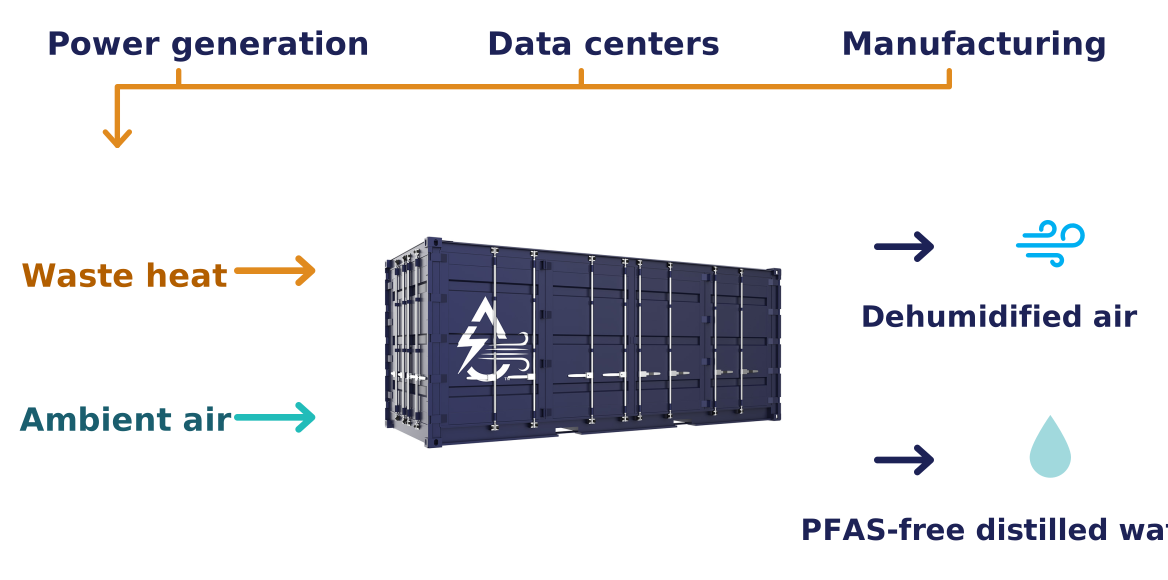
Sources: “Estimating the Global Waste Heat Potential,” Renewable and Sustainable Energy Reviews (2016); U.S. Department of Energy, Waste Heat Recovery Basics.
Pure by design
The output is distilled water that meets FDA bottled water standards and California drinking water standards. It can be used as distilled water for industrial processes or remineralized for drinking. Because the process is a triple purification (selective capture, vacuum distillation, condensation in NSF-compliant materials), it does not depend on the quality of a source supply.
Two platforms, one technology
AirJoule Prime scales the process to sixteen sorbent chambers in a containerized unit for industrial water generation. AirJoule Core uses two chambers for industrial dehumidification.
Where it is running
Newark, Delaware
First full-scale Prime, operating since May 2026.
Niskayuna, New York
Core at GE Vernova’s Advanced Research Center.
Expo City Dubai
Core demonstration program.
Europe
First Prime data center deployment, Q4 2026.
